La Géométrie de la reconstruction de la mémoire

Les vases
Les paniers
Les nattes
Le textille
Reconstructing the past through geometry often involves analyzing ancient structures, artifacts, and historical documents to understand the mathematical principles used by past civilizations. It's a fascinating field that combines archaeology, mathematics, and history to piece together the knowledge and practices of earlier societies.
Geometry plays a crucial role in understanding how ancient civilizations designed and built structures such as pyramids, temples, and monuments. By studying the dimensions, angles, and geometric patterns present in these structures, researchers can uncover insights into the mathematical knowledge, cultural beliefs, and technological capabilities of past societies.
Additionally, ancient texts and manuscripts sometimes contain mathematical equations and geometric diagrams that provide further clues about the mathematical practices of earlier civilizations. Overall, reconstructing the past through geometry offers a unique perspective on the development of human knowledge and civilization.
In addition to architectural marvels, geometry was also integral to ancient civilizations in various other aspects of life.
For example, ancient astronomers used geometric principles to track celestial movements and develop calendars.
Geometric shapes and patterns were also prevalent in art, pottery, and religious symbols, reflecting cultural values and beliefs. By studying the geometric artifacts and texts left behind, historians and archaeologists can gain insights into the intellectual achievements and societal structures of past civilizations, enriching our understanding of human history.
Geometry served as more than just a practical tool for construction and measurement; it was also deeply intertwined with the philosophical and spiritual beliefs of ancient cultures. For instance, the ancient Greeks saw geometry as a pathway to understanding the fundamental principles of the universe, connecting geometric shapes and proportions to concepts like harmony, beauty, and the divine.
Similarly, ancient cultures such as the Egyptians and Mesopotamians imbued geometric symbols with religious and mystical significance, using them in rituals, ceremonies, and religious iconography. Therefore, studying geometry in the context of the past offers not only a glimpse into practical applications but also a window into the metaphysical and philosophical underpinnings of ancient societies.
In some cases, the study of ancient geometry involves deciphering encoded messages or hidden knowledge embedded within geometric designs or architectural layouts. For example, the ancient Egyptians incorporated geometric principles into the design of their pyramids, potentially encoding mathematical and astronomical knowledge for future generations.
Similarly, the layout of ancient cities, such as the grid patterns of Roman towns or the sacred geometry of Mesoamerican cities, may hold clues about urban planning, social organization, and cultural beliefs. By unraveling these geometric mysteries, researchers can gain deeper insights into the mindset and intentions of past civilizations, shedding light on their worldview and aspirations.
One example of a geometry reconstruction exercise involves analyzing the layout and dimensions of an ancient structure, such as a temple or a pyramid, based on archaeological evidence and historical records.For instance, researchers may use measurements of the remaining ruins or architectural plans to reconstruct the original dimensions and proportions of the structure. By applying geometric principles such as symmetry, proportionality, and trigonometry, they can infer details about the building's design, construction techniques, and symbolic significance.
Additionally, geometric analysis can be used to uncover patterns or relationships within the structure, such as the alignment of architectural features with celestial phenomena or the incorporation of geometric symbols into the design.Through these exercises, scholars can gain insights into the mathematical and cultural knowledge of the civilization that built the structure, as well as the societal values and beliefs that influenced its design.
La géométrie qui consiste a reconstituer le patrimoine culturel et artistique perdue.


 L'une des figures géométrique populaire dans la culture punu.

 L'une des figures géométrique populaire dans la culture punu.
Il représente les 9 tribus. Quelque fois l’étoile, la cosmogonie bantou. Dieu , les deux premiers couples et les quatre point cardinaux.


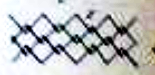


- Les nœuds


- Les défenses de l'éléphant

A combination of the Pythagorean Proposition with its generalization
What result may be obtained when one combines the theorem (2)

- L'un motif du serpent.


-les cauris

-Léopards


Dytu di dinimb, palme de raphia pagnes.
Quelques motifs d'autrefois..


Archaelogical Ceramics Restoration
Les activités de pêches


Le tissu Ndengi


Comments
Post a Comment